- Founders Pack Wolfcast: Learn from Unicorn Startups Before They Raise $1 💸
- Posts
- A Nineteen-Year-Old Is Growing Brains to Replace Your GPUs
A Nineteen-Year-Old Is Growing Brains to Replace Your GPUs
Frontier Computing's Michael Domarkas culturing living neurons into exascale compute — $10M pre-seed, a Frogger-playing brain in a dish, and the end of the silicon bottleneck.
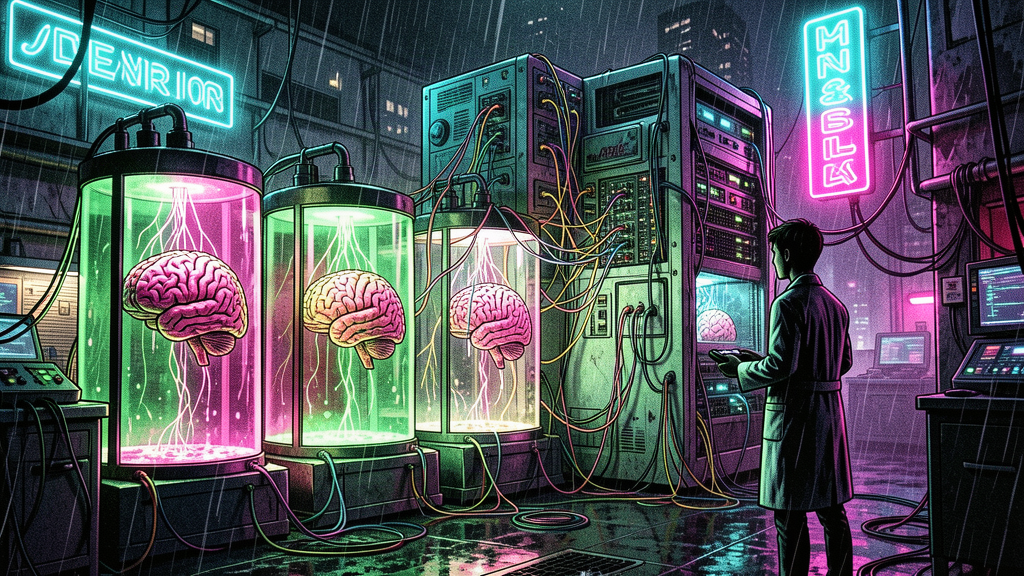
$10 million. One brain in a jar. And a nineteen-year-old who told the GPU industrial complex to eat its own lunch.
I've covered startups the way I used to cover the Kentucky Derby — from the cheap seats, with a bottle in my coat and a typewriter that smells like ozone. I've seen a thousand founders pitch me their SaaS. Their productivity app. Their "AI-powered thing for businesses." Ninety-nine percent of them could be a spreadsheet with a nervous breakdown.
Then I met Michael Domarkas. He grows brains.
Not metaphorically. Literally. In a wetlab outside Cambridge. Little pink clumps of real, living, cultured neurons — and he's wiring them into a supercomputer like they're the cheapest damn chips on earth.
The kid who grows hardware in a dish
Michael Domarkas is nineteen. He studied natural sciences at Cambridge. At seventeen he was culturing neural tissue in his bedroom on a twenty-thousand-dollar grant from Emergent Ventures, the libertarian mad-scientist fund that has backed half the weirdos I've ever profiled.
He taught himself to code at eight. C#. Unity. Video games. Then he went and read about how a single human brain runs on twenty watts while a GPU cluster trying to imitate it eats a megawatt and a small power plant's worth of cooling.
He looked at the entire multi-trillion-dollar AI industry — the datacenters, the H100s, the water-cooled basements full of Chinese GPUs — and asked the question that makes venture capitalists check their pulse:
What if the hardware grew itself?
The vascularisation problem
Here's the wall that stopped every biocomputing lab before him. Neurons in a dish die past a certain size. Not because they're fragile — because a growing clump of cells gets too far from the oxygen supply. The cells in the middle suffocate. Academia had been stuck at around a million neurons for years.
That's the vascularisation problem. And it's the kind of problem that ends PhD careers.
Domarkas broke it. A novel tissue-culture approach that feeds the whole structure. Now he's not stuck at a million neurons. He's scaling toward one hundred million. Five hundred million. Exascale. The largest biological brains ever grown on purpose, wired as compute.
His neurons played Frogger. Ninety-two percent crossing rate after one hour of real-time learning. A clump of wet cells, alive, taught itself to guide a frog across four lanes of cars and a river of drifting logs. That's not a benchmark. That's a quiet apocalypse wearing a lab coat.
"When the Apple II came out… the thing that made Apple was the first commercial usable version a non-engineer could use. That moment hasn't happened yet for AI. The Homebrew Computer Club for AI is happening right now."
— Garry Tan, via TheFoundersPack
Garry gets it. The Homebrew Computer Club for AI is a nineteen-year-old growing a brain in a dish and plugging it into the wall. This is what that club looked like in 1975 — a bunch of misfits doing the thing the establishment swore was impossible, in a garage, for pennies.
Memory baked into the cell
Here's the part that keeps me up. GPUs have a fundamental bottleneck. Memory and compute live on opposite sides of a bus, and shuttling data between them is the thing that caps your model size. The bandwidth is the wall.
Neurons don't have that problem. Memory and compute are the same goddamn thing — the connection weights are the hardware. Memory baked in at the cellular level. Continual learning, not retraining from scratch. Sample efficiency that would make an RL researcher weep.
Frontier sits an abstraction layer above backprop. You don't need a trillion-parameter GPU cluster. You need a dish, an electrode array, and a kid who knows how to keep cells alive.
One founder. A pack forming around him.
Here's the part I actually believe in, the part that fits this newsletter's whole damn thesis. Domarkas is a solo founder. One nineteen-year-old with a wetlab. But he didn't try to be a lone wolf — he reached for a pack.
Ten million pre-seed, led by General Catalyst. LocalGlobe. KAYA. Long Journey Ventures. Amino Collective. The money isn't the point. The point is he recruited a mastermind wolf — a coalition of funds that usually bet on enterprise SaaS — to bet on a kid growing brains. And he's hiring a founding CSO, a principal investigator, electrical engineers, neurobiologists, RL researchers. Building a pack of specialists, not a cult of one.
That's the oldest move in the book. The keiretsu. Cross-shareholding, shared talent, a common asset nobody could build alone. A lone wolf can't grow an exascale brain. A pack can.
The shape of the next decade
He's promising a 500-million-neuron cluster by January 2027. That's 2,500 times larger than the biggest publicly available biocomputing system on earth right now. If he hits it, he hasn't built a chip. He's built a new kind of factory — one that grows its own silicon replacement.
And it's the same shape as any pack: a small team betting on a vision the establishment calls insane. If you want to see what that looks like when it works, go ask GenFlick — an AI filmmaking agent that lets one person direct an entire movie, the same "small team, huge leverage" bet. Try GenFlick free and feel the thing that frontier feels: a few people, pointed at a horizon, betting they can move it.
Don't tell me the GPU is the only way to compute. Don't tell me a kid can't grow a brain in a dish. The last guys who told me that are still waiting for the datacenter they'll never afford.
Michael Domarkas is going to make the chips obsolete. Or die trying, broke and brilliant, in a Cambridge wetlab. And honestly? I'm not sure which ending scares the establishment more.
 Michael Domarkas — Founder & CEO, Frontier Computing. 19-year-old ex-Cambridge natural scientist who grows biological brains as ML training substrate. @MichaelDmrks | LinkedIn
Links: YC Profile | Website | Launch Post | @MichaelDmrks | Partner: Harshita Arora
Join the Pack
Read Form Your Own Pack: How a Forgotten Japanese Business Model Teaches Startups About the Power of Cooperation.
The ideas in this newsletter come from Form Your Own Pack — the book that started it all.
Get the Book on Amazon →